
Employee disability insurance is one of those benefits that feels invisible right up until the day it is the only thing that matters. Nobody asks about it during onboarding. Nobody brags about it at hiring fairs or happy hour. But when an injury, illness, or unexpected diagnosis takes someone out of work, this coverage becomes the financial safety net holding everything together.
That is when flaws show up fast. Confusing definitions. Long waiting periods. Coverage that looks fine on paper but falls short in real life. Employees feel exposed. Employers feel blindsided. And trust takes a hit at the exact moment you can least afford it.
Disability benefits are not a box to check. They are a promise. When life goes sideways, this is the benefit employees remember. Let’s dig in to see what disability benefits are really about.
Short-Term and Long-Term Disability Are Different Tools
Short-term disability and long-term disability are often discussed together, but they solve different problems. Short-term coverage, also called paycheck protection insurance, typically replaces a portion of income for a limited window following an injury, illness, or childbirth. Long-term coverage steps in when someone cannot return to work for months or even years.
Imagine an employee slips while shoveling snow. They face multiple broken bones, several surgeries, and weeks spent bedridden. They’ve got plenty to worry about, and being able to pay the rent or buy groceries shouldn’t be another thing on that list. Short-term disability covers this kind of situation. It usually doesn’t replace an entire paycheck, but it makes sure there’s still money coming in during the recovery period.
Long-term disability might come into play for something like a cancer diagnosis, where treatment and complications keep a team member out of the office for many months. They can focus on fighting their illness, rather than the fact that their paycheck has evaporated.
Well-designed programs coordinate both policies so income continues smoothly. Poorly designed ones leave gaps that employees fall straight through. This is where experience matters more than guesswork.
Plan Design Is Where Most Employers Slip
The details matter. Waiting periods. Benefit percentages. Maximum durations. Definitions of disability. Own-occupation versus any-occupation language. These are not minor footnotes. They determine whether coverage works when it is needed.
On paper, disability plans can look deceptively similar. In practice, small differences drive big outcomes. A waiting period that is too long can force employees to drain savings before they see a penny from the plan that is supposed to protect them. A strict definition of disability can trigger claim denials. Weak claims administration can turn a stressful situation into a nightmare.
The goal is not to overbuild. The goal is to align coverage with how your workforce actually lives and works. Physically demanding roles may need stronger short-term coverage. Office-based or remote teams may need broader mental health protections. Higher earners may face income gaps if benefit caps are too low.
The ideal design for someone else’s workforce could be disastrous for yours. Getting it right matters, and that starts with understanding how seemingly minor plan differences have a major impact when an employee gets sick or injured.
Why Broker Expertise Changes the Outcome
An experienced employee benefits broker doesn’t start with products. They start with questions. Who is your workforce? Where are the risk points? How do absences really impact operations?
From there, they evaluate carriers based on claims performance, not just pricing. They read policy language instead of skimming summaries. They design plans that function under pressure, not just during enrollment season.
This is the difference between buying insurance and building protection. One is transactional. The other is intentional.
Communication Makes or Breaks Disability Benefits
Even the best-designed plan fails if employees don’t understand it. You and your broker can put together a perfect plan, but that’s meaningless if no one knows what it provides and how to use it. Disability insurance is often confused with workers’ compensation or assumed to apply only in extreme cases. Some employees don’t know they have coverage at all until a crisis hits.
Clear communication fixes that. Simple explanations. Real-world examples. Straightforward guidance on how and when to file a claim. Employees should know what the benefit does before they ever need it.
Your broker should be helping with this, too. If they are good at what they do, their work doesn’t stop when you choose a policy. They help you communicate that policy to your people.
When education improves, utilization improves. When utilization improves, trust follows. HR teams also spend less time untangling confusion during already stressful moments.
Claims Support Is Where Trust Is Earned
Filing a disability claim rarely happens during a calm season of life. Employees are dealing with medical uncertainty, financial anxiety, and personal stress all at once. A slow or confusing claims process compounds the damage.
Strong broker support matters here. Experienced brokers know how carriers operate behind the scenes. They can escalate delays, clarify requirements, and advocate when something feels off. They also help HR coordinate overlapping responsibilities like leave management and return-to-work planning.
Employees remember who helped them when things were hard. That memory lasts far longer than any enrollment meeting.
Strategy First, Not One-Size-Fits-All
The best disability programs are built deliberately. They account for workforce demographics, income distribution, and operational risk. They balance cost with participation. They offer flexibility where it makes sense and structure where it is needed.
That might include voluntary buy-up options. It might mean adjusting employer contributions to encourage enrollment. It might mean aligning disability benefits with broader wellbeing initiatives.
This approach protects people and stabilizes your business at the same time.
Compliance Is Part of the Design
Disability benefits operate inside a regulatory maze. The walls of that maze are state rules, ERISA requirements, documentation standards, and reporting obligations. Miss something, and the consequences can escalate quickly.
Employers operating across multiple states face even more complexity. A thoughtful broker helps adapt plans without creating confusion or inconsistency. Compliance becomes part of the architecture, not an afterthought patched on later.
That protection is invisible when done right, which is exactly the point.
Disability benefits tell employees what you value when productivity is no longer the metric. They show whether support disappears when things get difficult or holds steady when it matters most.
When designed well, disability coverage builds loyalty, reduces long-term disruption, and reinforces a culture of stability. When designed poorly, it exposes cracks that are hard to repair.
If your disability benefits haven’t been reviewed in a while, or if you’re not confident about how they would perform during a real claim, that is worth a closer look. A thoughtful conversation with a broker now can prevent painful surprises later.
Video

Infographic
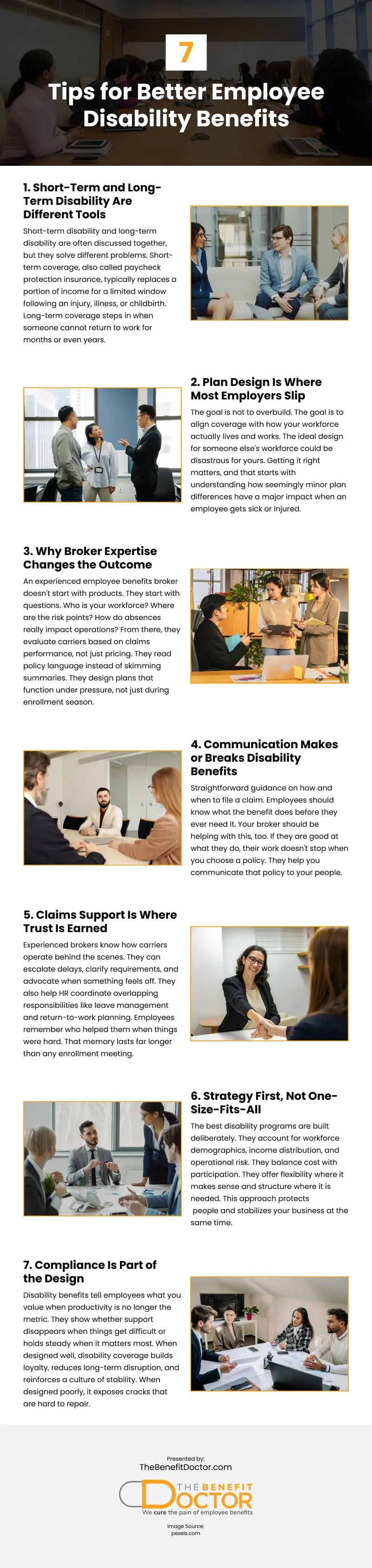
Employee disability insurance is often overlooked until it becomes essential during unexpected illness or injury. This benefit acts as a financial safety net, providing stability when someone can’t work due to health issues. Check out this infographic for tips on strengthening employee disability coverage.