
Managing employee benefits costs can feel like trying to hit a moving target in the dark. Premiums rise. Employee expectations shift. Every renewal season brings a new round of tradeoffs.
You want to control costs while also getting a package that actually helps you attract and retain good people. That balance gets harder to maintain when you’re working with incomplete information or a broker who only surfaces when it’s time to sign paperwork.
The right health insurance brokers for businesses help you break that cycle. You get more than a rate comparison. You get a clearer view of what’s driving your costs, where your plan is working, and where it’s quietly bleeding your budget.
That kind of guidance changes everything. Instead of reacting to increases every year, you start making smarter decisions with a real long-term strategy behind them.
Why Benefits Costs Feel Harder to Manage Now
Benefits costs used to feel more predictable. Those days are gone. Healthcare prices keep climbing. Employees expect broader support for mental health, family needs, and financial wellness. Plan designs have grown more layered, and compliance rules don’t leave much room for guesswork.
If you run a small or mid-sized business, that complexity hits harder. You probably don’t have a dedicated internal team focused solely on benefits strategy. You still carry full responsibility for those decisions, though, and they affect both your bottom line and your employee experience. When the process lacks clarity, you end up spending more while feeling less confident about what you’re actually buying. That’s a frustrating place to operate from, and it’s avoidable.
This is where a trusted broker earns their place. They help you understand the landscape in a way that feels practical instead of overwhelming.
A Good Broker Helps You See What’s Actually Driving Costs
Benefits costs don’t rise for one single reason. Claims patterns, plan design, carrier pricing, employee utilization, and administrative structures can all play a role. If your broker’s best explanation is “costs are up everywhere,” that’s not analysis. That’s a shrug in a suit.
You need someone who can break the numbers down and explain what they actually mean. Are specialty prescriptions pushing claims higher? Are employees defaulting to expensive care settings because nobody explained their options? Is your current plan design quietly encouraging inefficient spending?
Those are the questions that lead to real changes. A sharp broker delivers that clarity without dressing it up in jargon, and that clarity gives you something to act on.
Plan Design Is More Important Than Most Employers Realize
Most employers zoom in on premiums first. Premiums matter, but plan design shapes how employees use the plan, how much they value it, and how sustainable your costs become over time. Getting the design right is just as important as chasing a lower rate.
A broker with strong strategic instincts helps you evaluate whether your current structure still fits your workforce.
Maybe you need better preventive care incentives. Maybe your deductible structure is creating unnecessary financial stress and driving people away from care they should be getting. Maybe your ancillary benefits look great on paper, but do almost nothing for retention or employee confidence.
Adjustments in those areas affect both cost and culture. Benefits that are hard to use get ignored. Benefits that are thoughtful and well-designed tend to perform better for everyone.
Carrier Negotiation Is Only Part of the Job
Many employers assume a broker’s main value is scoring a better rate. That matters, but it’s one piece of a much bigger picture. A strong broker does negotiate with carriers, but they also dig into the contract details behind the rate.
A lower number can hide narrow networks, weak support, or renewal terms that become painful 12 months later. The right broker helps you weigh the full picture, not just the headline price. They explain where the tradeoffs are and which ones actually make sense for your business.
That guidance keeps you from buying short-term relief that creates long-term instability. It also means you walk into renewal season with a strategy instead of a scramble.
Cost Control Gets Stronger With Effective Communication
You can build a genuinely smart benefits package and still lose most of its value if employees don’t know how to use it. Confusion leads to poor care decisions, missed preventive visits, and frustration that gets blamed on the plan itself. All of that drives up costs and erodes trust in ways that are easy to miss until the damage is already done.
An employee benefits consultant worth their fee helps you improve communication, not just deliver a packet of documents during open enrollment. Employees need plain-language guidance on what their plan covers, where to go for care, and how to make decisions that protect both their health and their wallet.
When people actually understand their benefits, they make smarter decisions. That improves satisfaction and cuts waste across the plan at the same time.
Compliance and Renewals Get Easier With the Right Support
Benefits management includes more than cost control. Compliance and renewal handling are both critical, too. When those areas feel rushed or unclear, problems tend to stack up fast.
A dependable broker keeps you ahead of deadlines, documentation requirements, and regulatory obligations. They don’t treat renewal like a one-time transaction. They help you prepare earlier, review your options with enough time to think clearly, and avoid the passive decisions that lock in preventable cost increases year after year.
That support reduces stress on your leadership team and creates genuine confidence in the process. With the right broker as your partner, you spend less time chasing answers and more time evaluating what actually serves your business.
What To Look For In A Trusted Broker
Not every broker brings the same level of value, and the difference shows up long before renewal season. If you want a broker who helps you navigate benefits costs strategically, pay attention to how they work throughout the year. A strong broker usually does a few things consistently:
- They explain cost drivers clearly and back recommendations with useful data.
- They help shape plan design, not just compare carrier quotes.
- They communicate proactively before renewal season turns urgent.
Those habits sound simple, but they make a major difference in how your benefits program performs over time.
Why Trust Changes the Whole Relationship
Trust matters in benefits because the stakes are real. You’re making decisions with financial, legal, and human consequences. You need to believe your broker is protecting both your people and your budget, not just protecting their renewal commission.
That trust grows when they’re transparent, willing to challenge your assumptions, and invested in your outcomes year-round, not just at signing. The right broker turns benefits management into a strategic asset instead of an annual headache. You gain insight, stronger control over expenses, and a clearer path toward decisions your employees can actually feel.
If your current broker isn’t bringing that to the table, it might be time to raise your standard.
Video

Infographic
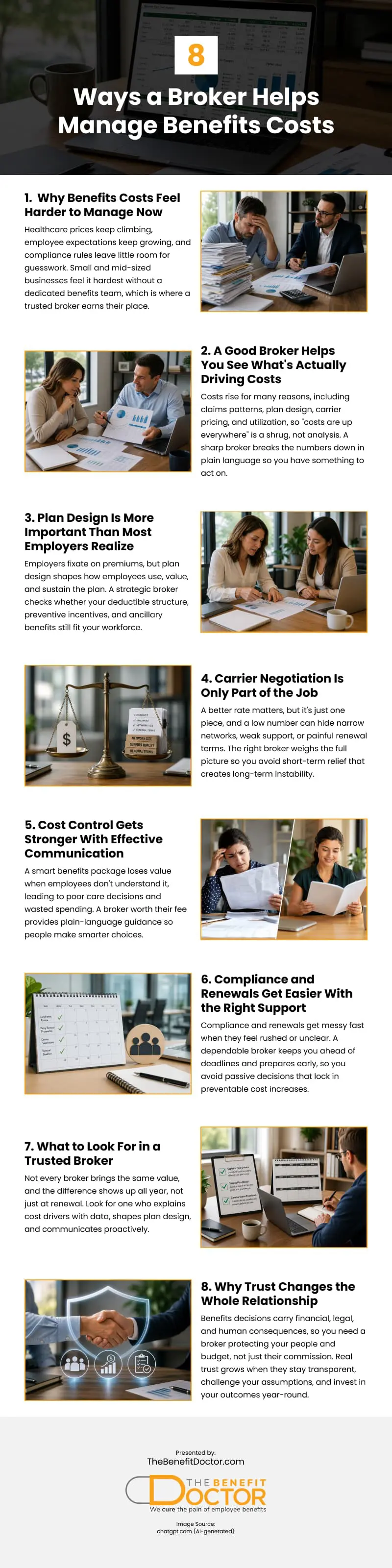
Rising benefits costs can pressure your budget while you still try to attract and keep great employees. Find out how the infographic below explains eight ways a broker helps manage benefits costs, so you can save money without cutting coverage.